lunes, 19 de abril de 2021

PREFIXES


PREFIXES

Los prefijos son letras o grupo de letras que se añaden al principio de una palabra raíz para modificar su significado. Pueden modificar un nombre, verbos, adjetivo o adverbio. Los prefijos otorgan una cualidad nueva a la palabra raíz como negación, repetición, revertir una acción o estado, etc; pero no cambian la función de palabra. Es decir, un verbo seguirá siendo verbo aún cuando se le añade un prefijo.


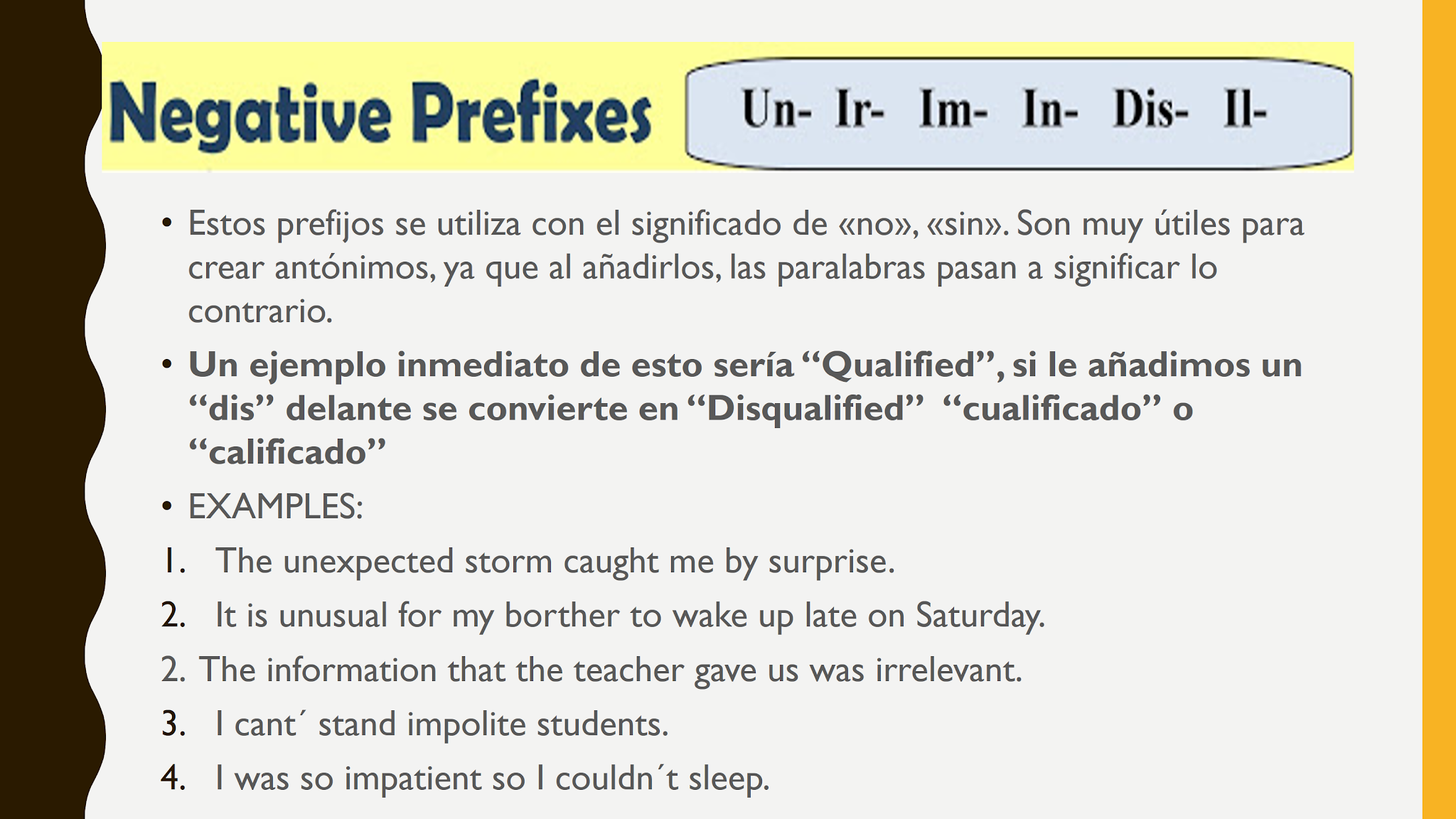
He is sleeping in uncomfortable position

She is a dishonest person. She always cheats in her exams.

COMMON PREFIXES


Cuando añades un prefijo “dis-“, “un-”, “in-“, im-“, “ir-“, y “-il”, la palabra se convierte directamente en lo contrario, es decir, estás usando un antónimo


RELATIVE CLAUSES AND RELATIVE PRONOUNS

 CHECK AND PRACTICE RELATIVE CLAUSES AND RELATIVE PRONOUNS

RELATIVE CLAUSES:  Las relatives clauses u oraciones relativas son frases que se unen a una oración y sirven para proporcionar información sobre una persona, objeto, animal, lugar que se ha mencionado previamente en la oración principal.

Por lo tanto, son oraciones subordinadas que se unen a la frase principal mediante los relative adverbs or pronouns. (pronombres o adverbios relativos ) Estos son  Who,  Whom. Which, why, when, where, whose, that.


cláusula = sujeto + verbo

Las cláusulas son las partes básicas de las oraciones en el idioma inglés. Es un grupo de palabras relacionadas que contiene un sujeto y un verbo. Un sujeto es quién realiza la acción o de quién se dice algo. 


Un verbo es la palabra de acción en la oración.

Ejemplo: The dog jumped over the fence.


cláusula independiente =
idea completa

Las cláusulas independientes son oraciones completas. Se forman e inician con una letra mayúscula y termina con un signo de puntuación, como un punto. Ejemplo


He is my son. 

My son is 10 years old.


cláusula dependiente =

Las cláusulas dependientes contienen un sujeto y un verbo pero NO expresan una idea completa, por lo tanto no pueden ser una oración. Ejemplo: While Tom reads a book...
La cláusula dependiente debe estar conectada con un cláusula independiente para formar una oración completa. Ejemplo

RELATIVE PRONOUNS: Los pronombre relativos los empleamos cuando nos referimos a un sustantivo (una persona, lugar, cosa, animal) mencionado antes y al que queremos adicionar más información o modificar. Se puede referir de forma singular o plural. Además, se utilizan para unir dos o más cláusulas relativas, formando así lo que llamamos "RELATIVE CLAUSES". 

Se anexa, una lista de pronombre relativos.


"Who":  Es un pronombre con función de sujeto quien realiza la acción presentada por el verbo.(Quién-quiénes). Example:  The woman who called me yesterday wants to buy a house ( La mujer quien me llamó ayer quiere comprar una casa)

"Which"  Se utiliza cuando el sujeto al cual nos referimos es una cosa, animal, lugar.(que/ el cual/ la cual / los cuáles/ las cuales) Ejemplo: Did you see the letter which came today? ( Viste la carta que llegó hoy?


"Whom": Es un pronombre con función de objeto que recibe la acción expresada por el verbo (a quien- a quiénes). Al actuar como objeto no sería el encargado de realizar la acción . Su rol es averiguar sobre quién recae la acción.


" Whose" Su uso indica posesión tanto para las personas como para las cosas, actuando como cualquier pronombre posesivo ( de quíen, cuyo, cuyos) es decir hace referencia a mine, yours, his/ hers, its, ours- Ejemplo: Whose book is this? ( De quién es este libro? This is mine. ( Es mío)

"That" Se puede usar como sujeto o completo directo y se puede referir a personas, animales y cosas (que).
Ejemplo: Maria is at the school that is near her house. (Maria está en colegio que está cerca a su casa)


viernes, 26 de marzo de 2021

CONDITIONALS: FIRST AND SECOND

 FIRST AND SECOND CONDITIONAL

1. First Conditional

The first conditional is a structure used for talking about possibilities in the present or in the future.

How to form a complex sentence with the first condtional
If clauseMain clause
If + subject + verb in the present tenseSubject + will + verb
  • If the weather is nice,
  • we’ll go swimming.
  • If you study hard,
  • you will pass the test

2. Second Conditional

The second condtional expresses unreal situations in the present or future.

A second conditional sentence consists of two clauses, an "if" clause and a main clause.

How to form a complex sentence with the second conndtional
If clauseMain sentence
If + subject + verb in the past simple tenseSubject + would + verb
  • If I had a million pounds,
  • I would buy a big yacht.
 

LET'S PRACTICE

EXCERCISE 1 https://es.liveworksheets.com/eo56399ys  

                         https://es.liveworksheets.com/bl1263359st 

Open the link and do the exercises. When finished it send your answer through your teacher's email yennygarciar@iesbgarzon.edu.co. 

EXCERCISE 2 


MORE LINKS TO PRACTICE

1.https://www.esl-lounge.com/student/grammar/3g18-first-second-conditional-exercise.php

2. https://www.english-4u.de/en/grammar-exercises/conditional-clauses3.htm

3. https://www.englishexercises.org/makeagame/viewgame.asp?id=6085

DON'T FORGET LEAVE SOME COMMENTS BELOW!


Just a Reminder! Do not forget to download the pdf file with the digital resources. Here you will find useful links, websites and apps to practice your English skills.  https://drive.google.com/file/d/1bkYFEASEOl4g9wek5iP4dyCuy-FzB_4g/view?usp=sharing  RECURSOS DIGITALES ÁREA DE INGLÉS 


ACTIVE AND PASSIVE VOICE


LET'S LEARN AND PRACTICE ACTIVE AND PASSIVE VOICE


LET´S DO THE PASSIVE AND ACTIVE WORKSHEET THROUGH THIS LINK https://www.liveworksheets.com/1-uf1885428pv. DATELINE APRIL 30TH
GRAMMAR AND VOCABULARY:


REWRITE SENTENCES: 

WORD ORDER:

GAMES:

SPEAKING BOARD GAME


LISTENING ACTIVITIES: 

5- Listen to the story "The stolen car" Complete the story with the words given . Then answer the questions.


READING ACTIVITY:

1- Read the story " The tornado and choose the best answer according to the information given.


2- Read the story "Jane´s New School" and choose the best answer according to information given in the story"


GRAMMAR ACTIVITY


DOWNLOAD:


4. Turn the following sentences into active or passive.
A. She pays a lot of money. ______________________
B. A picture is drawn by her. ______________________
C. She didn't win the prize. ________________________
D. I am  reading a story. __________________________
E. A letter was being written by me. ___________________
F. I have eaten a sandwich. _________________________
G. Has he been phoned by her? _______________________
H. They will send Ben to a new school. ____________________


5. Turn the following sentences into active or passive.
A. They sing the song.
B. The blue car was stolen by the man.
C. A song is being sung by her.


Leave your comments below

Just a Reminder! Do not forget to download the pdf file with the digital resources. Here you will find useful links, websites and apps to practice your English skills.  https://drive.google.com/file/d/1bkYFEASEOl4g9wek5iP4dyCuy-FzB_4g/view?usp=sharing  RECURSOS DIGITALES ÁREA DE INGLÉS


PREPOSITIONS

 PREPOSITIONS PRACTICE ONLINE:  1- https://agendaweb.org/exercises/grammar/prepositions/time-1 2- https://www.grammar.cl/Games/At_On_In_Time...